Wednesday, April 13, 2011

Liz Napier


Barbara Schneider


Tree Line

My on-going interest in the Japanese concept of Wabi-Sabi - finding beauty in things that are imperfect, impermanent, and incomplete, is at the core of all of my art work. I am interested in the translation of real to abstract imagery and in looking at pattern in the natural world. I try to capture the essence of images made of light, pattern and movement, images that are infinitely variable. I think about what the eye sees, what the camera sees, what the mind sees.

I collect leaves, pods, stems, bark, flowers and grasses and look closely at their structure and shape. Enlarging them helps me to see them as sculptural objects. Shaping my art cloth introduces a new element -- light and shadow interacting with the undulating surfaces.

Tree Line is an interpretation of the patterns of birch trees in the forest. It continues my exploration and interpretation of natural images by enlarging and reshaping them. Tree Line creates the feel of a forest but also explores the use of line and pattern in many ways--the vertical line of the seven panels, the short horizontal cracks and vertical irregular lines created by the wax, the red stitched outline, and the overall patterning and shape created by the background stitching.

Reflection on the relationship of these ideas to the Wabi-Sabi concept is what I do throughout my work process and it is what I hope viewers do as they look at the completed work.

Biography

Barbara Schneider began quilting in 1996 and rediscovered the pleasure of working with cloth, paint, dye, and thread. Her background is in visual design and, for many years, she worked as a designer in the publishing industry. Schneider makes handmade paper and collects Japanese folk art. Her on-going interest in the Japanese concept of Wabi-Sabi, finding beauty in things that are imperfect, impermanent, and incomplete, is at the core of all of her art work. She likes to capture the essence of images made of light and movement, images that are infinitely variable. She asks questions about what the eye sees, what the camera sees, and what the mind sees. Her artwork is exhibited nationally and internationally and is in many collections.

http://www.blogger.com/goog_1586118428
http://www.barbaraschneider-artist.blogspot.com/

Barbara Schneider


Jeanne Sisson


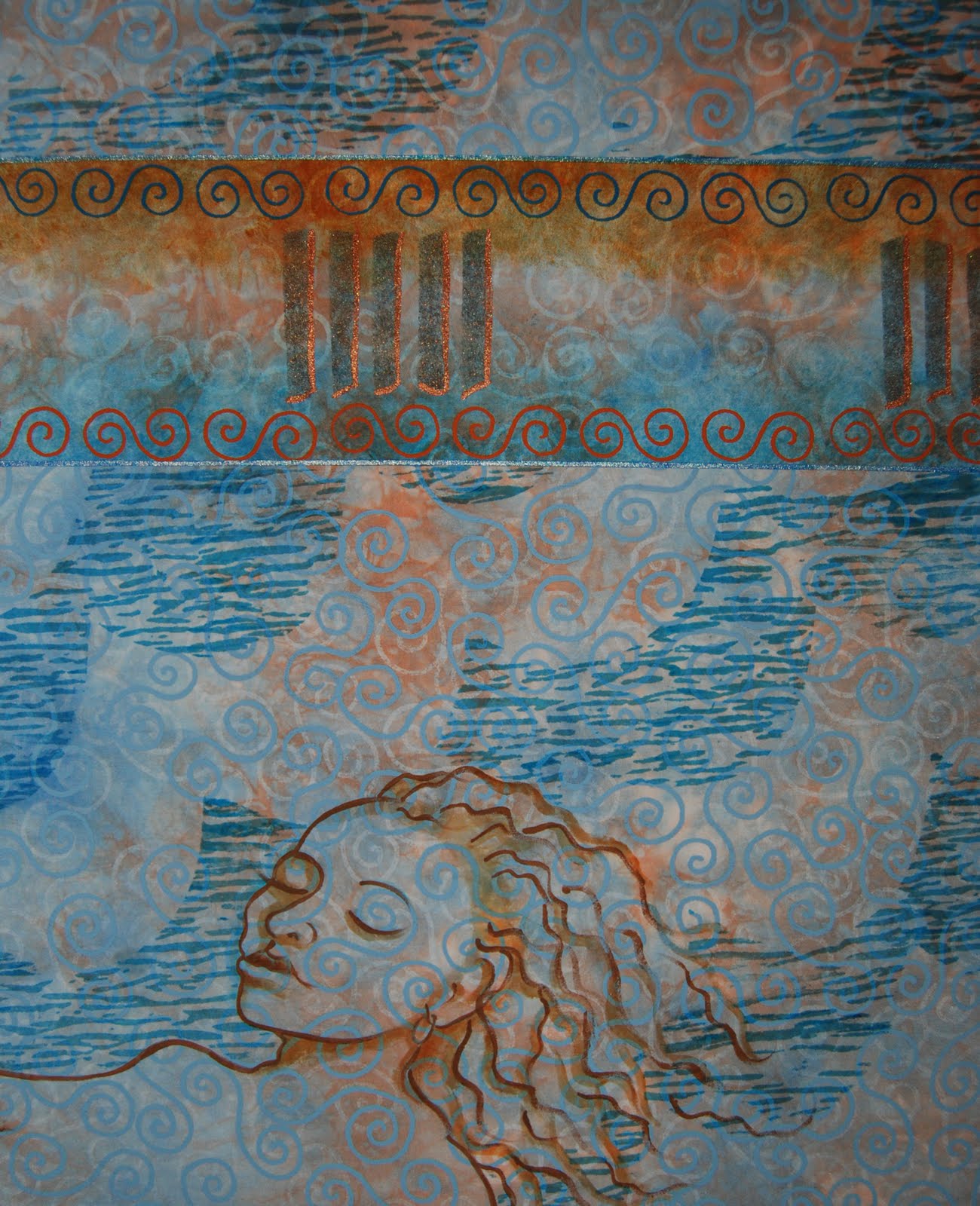
My Moment in Time

My art is my passion. The ability to use my imagination to develop a thought that invokes an image that I can share - without words - feels like a magical gift for which I am truly grateful.

There is a profound depth of beauty, vulnerability, and sensuality in the female silhouette that speaks to me. I try to reinforce the connection that I feel emanates from the female figure by creating a world in which that “symbol” tells a tale, triggers a memory or evokes an emotion. My hope is that anyone who views my work will be reminded of his or her own myth, memory, story, dream, or current reality.

I begin a piece by choosing a drawing from my artist journals that I feel a deep connection to. Often a drawing will speak to me with a certain idea or impression that I feel compelled to explore. From there I start to create a story or choose a myth or goddess that I feel depicts the figure I have chosen to work with. So begins my artistic love affair.... the process of planning the work; choosing the subject matter, creating a story, experimenting with colors and textures to support the imagery, and then orchestrating it all into a successful composition that speaks to others on many levels.

I am looking forward to continuing to explore the connections I have created between dreams, myth and story through imagery of the female form. I am especially excited about my latest artwork because I feel it has opened a door to my learning more about myself, as I am deeply connected to this work. As I am creating worlds for my artistic figures to live in, I am becoming more deeply connected to understanding (and embracing) myself.

Biography

Full-time artist, Jeanne Sisson, works in a home studio on a mountain with a sixty-mile western view of the Berkshire Mountains. Sisson’s paintings focus on incorporating textile dyeing, painting and printmaking techniques to capture the excitement of dynamic light and vibrant color on art cloth. She searches for inspiration through drawing from the model, an intimate connection to nature and gardening, and by recording her dreams. She unleashes her imaginative power equally whether placing a sensual nude into a dream-like serene environment or animating trees into whimsical dancing female forms. Sisson teaches textile and surface design workshops in western MA. She exhibits regularly at the Green Trees Gallery, in Northfield, and in various juried competitions nationally. She welcomes inquiries into her work and her home gallery is open by appointment.

jeanne@jeannesisson.com
http://www.jeannesisson.com/

Jeanne Sisson


Priscilla Smith


War Art

I make War Art to provoke thought and emotion; to raise consciousness; and to galvanize change. For many years of my life, I marched for peace. But that is not enough. The artist must also create “images” which reflect the horror and dark side of war.

It is the description of what war looks like by the French playwright, Jean Giradoux, in his play Tiger at the Gates: “war is like the bottom of a baboon....when the baboon is up in a tree, with its hind end facing us: scarlet, scaly, glazed, framed in a clotted filthy wig.” It is the picture of the Vietnamese girl running down a road, her skin shredding from napalm. It is a newspaper’s response to a reader who asked “...is it true that for every enemy soldier we kill in Vietnam, the United States kills six civilians?” . The newspaper replied “....no, this is not true. We only kill four civilians for every soldier we kill.” These are some of the images which will hopefully galvanize people to say “no more...no more killing...no more war.”

The processes and materials I use are designed to generate discomfort, sadness, disgust, and shock on the part of the viewer. I use images such as crosses with dead soldiers’ helmets perched on them, bodies torn apart, or burning buildings falling down. I use large overpowering images such as a dead soldier’s coffin, a menacing airplane, or an assault rifle. I intentionally use discordant colors. I use beautiful colors to create an awkward juxtaposition with a deadly weapon.

In making art about War, I am witnessing to my great respect for the soldiers who are sent off to fight. I do not respect the leaders who make the decisions to go to war -- the leaders who unthinkingly assume the conflict is between total good and total evil. The leaders, who through distortions and coercion, move the masses from believing a war is unnecessary to converts believing in a “just” war. The leaders who seek only more wealth and power.

Biography

Priscilla Smith began her art career working in batik during the 1970’s. For the next twenty years, she put her fiber arts career on hold to pursue a career as a Corporate Lawyer. Smith has won several awards for her art quilts and, in 2010, sixteen of her art quilts were featured in a solo show on Cape Cod, Massachusetts. In her conviction of the importance of raising consciousness about the impacts of war on human-kind, her recent work focuses on War Art. Her works have been featured in National Juried Exhibitions including One Passion, Many Voices in New Bedford, Massachusetts, Twelve Voices From One in San Antonio, Texas, and the Northeast Contemporary Fiber Exhibition in Rochester, New York, where she was awarded the Juror’s Choice Award.

http://www.blogger.com/goog_476294650
http://www.priscillajsmith.com/

Priscilla Smith